Improving 5-Axis CNC Milling Accuracy: A Guide to Avoiding 30% Cost Waste
Introduction
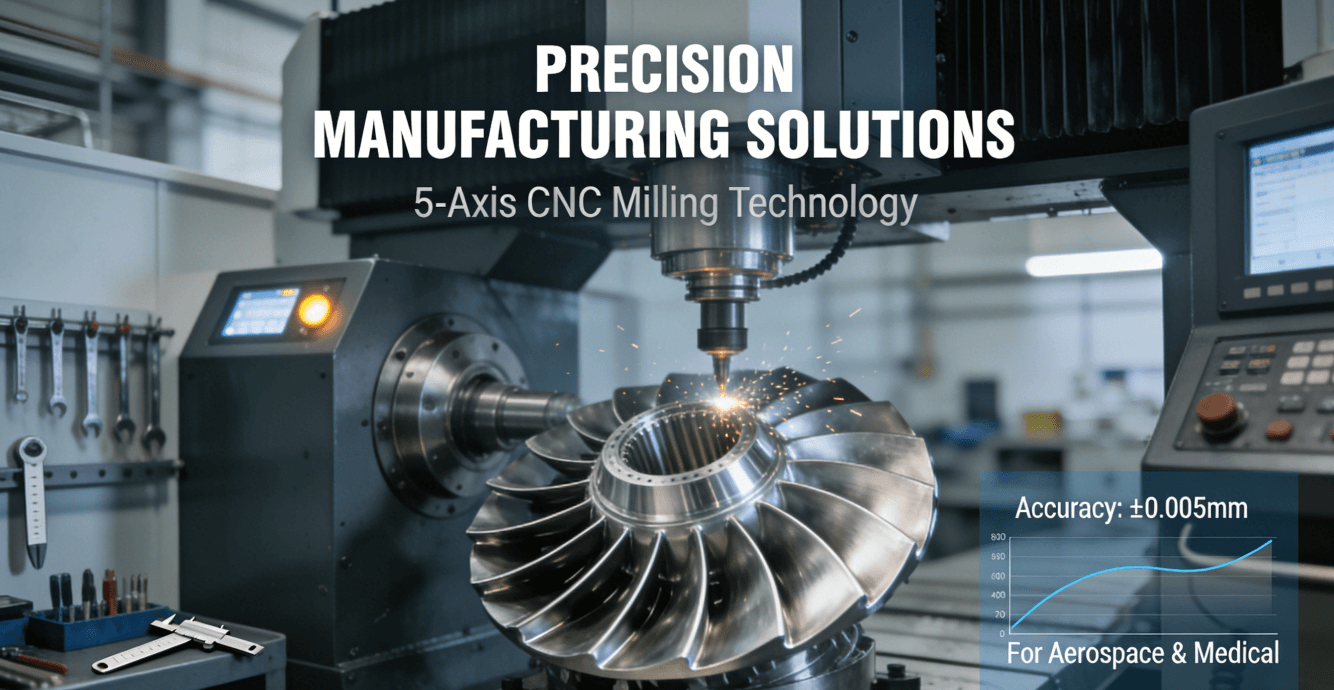
In the modern industrial setting, Precision Manufacturing Solutions are indispensable in the fabrication of parts that have to adhere to strict quality standards. As part of these solutions, high precision CNC milling is essential in fabrication, having been recognized for its ability to deliver a precision level of ±0.005mm.
This paper shall discuss the indispensable nature of CNC milling in modern fabrication, present comparisons between the 3-axis and 5-axis processes, describe quality assurance procedures, and evaluate cost-effective approaches. By abiding by international standards laid out in ISO 9001 and with the use of modern Quality Assurance Tools, leaders in the sector, are able to guarantee precision and efficiency in their work.
Why Do Precision Manufacturing Solutions Rely on High Precision CNC Milling?
Precision Manufacturing Solutions require uncompromising accuracy and repeatability, which are hallmarks of high precision CNC milling. This technology facilitates the production of complex components with stringent tolerances, ensuring functionality and interoperability across industries such as aerospace and medical devices .
Achieving Part Quality Through Stringent Tolerances
The secret to the CNC milling precision lies in the ability to hold tolerances of ±0.005mm. This ensures that every product meets exact specifications without any need for subsequent processing. The adherence to global standards such as ISO 9001 verifies the reliability of the precision. The companies that meet the standards show that they prioritize precision and improvement since precision is of utmost importance when it comes to critical applications.The process’s repeatability, driven by computer-controlled automation, ensures that every part in a batch matches the first exactly, eliminating human error and enhancing product reliability .
Critical Applications and Cost Management
The impact of high-precision milling is particularly evident in sectors like aerospace and healthcare.
Aerospace and Medical Devices
In aerospace, components such as turbine blades must exhibit flawless geometry to withstand extreme conditions. Similarly, medical implants demand biocompatibility and precise dimensions to ensure patient safety. High precision CNC milling meets these requirements by producing parts with exceptional accuracy and superior surface finishes .
Precision’s Influence on Costs
Though it requires an investment to obtain precise tolerances, it ultimately helps cut costs, which might have been incurred otherwise through assembly problems, rework, or product failures. When attempting to obtain precise tolerances, costs in the beginning might be high, but it saves costs in the long run. Another aspect that helps cut costs through CNC milling is automation .
What are the Key Differences Between 3-Axis and 5-Axis CNC Milling?
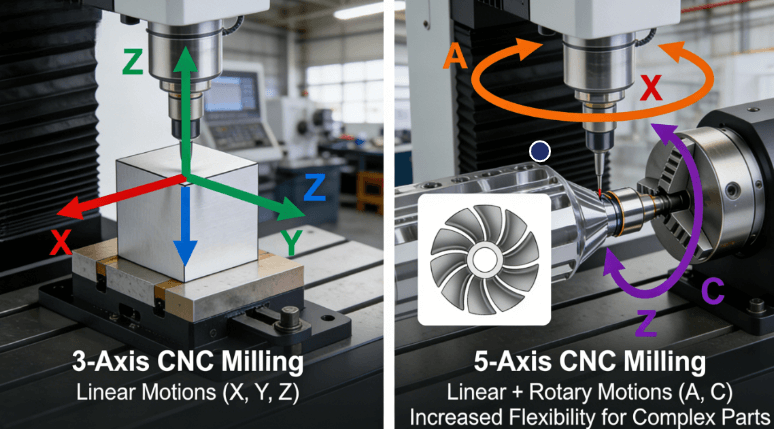
When comparing 3 axis CNC milling to 5 axis CNC milling, the major difference in the efficiency level, complexity, and capabilities for Custom Part Production is that while a 3-axis machine moves along the linear axes X, Y, Z, in a 5-axis machine, there are rotational axes that enable the creation of complex contours or undercuts without the need to reposition the workpiece. Therefore, the advanced functionality cuts down greatly on setup time, along with the cumulative error, which is a major advantage for Custom Part Production for complex parts.
With the rotational axes, the cutting tool is able to move towards the workpiece in any direction, which is very effective in the production process for creating impellers, as well as for instruments in the medical field, all in a single operation. For a detailed comparison, refer to this 3 Axis vs 5 Axis CNC Milling Guide . The evolution of multi-axis technology, supported by organizations like the National Institute of Standards and Technology(NIST) , underscores its role in meeting modern manufacturing demands for versatility and precision.
How is High-Quality Part Production Achieved Through 5-Axis CNC Milling?
5 axis CNC milling excels in producing high-quality CNC milling part components by enabling simultaneous multi-angle machining. This approach ensures superior surface finishes and dimensional accuracy, particularly for complex shapes like impellers or surgical instruments . The integration of Quality Assurance Tools, such as in-process monitoring and Coordinate Measuring Machines (CMM), allows for real-time detection of deviations, maintaining consistency across production runs. For instance, in drone component manufacturing, this methodology has reduced defect rates to below 0.2% . The process begins with advanced CAD/CAM programming, where toolpaths are optimized for 5-axis kinematics, allowing the tool to maintain the optimal orientation to the workpiece surface.
This not only improves surface finish but also permits the use of shorter, more rigid cutting tools, minimizing vibration and enhancing accuracy . Certifications like AS9100D further validate the reliability of these processes in critical industries, ensuring that every part meets the highest standards of traceability and quality management .
Is Low-Cost Precision CNC Milling Feasible?
Achieving cheap precision CNC milling is possible through strategic supply chain optimization and batch production. Sourcing from a CNC milling service china can reduce costs by up to 30% without sacrificing quality, thanks to economies of scale and efficient material procurement . Additionally, Rapid Prototyping Services accelerate development cycles, allowing for iterative testing and design refinements that prevent costly errors later in the production process .
Supply Chain and Batch Production Optimization
Leveraging global supply chains and volume discounts enables manufacturers to offset expenses associated with tight tolerances. Standardizing materials and processes also contributes to significant cost savings. For example, batch production allows fixed costs like setup and programming to be distributed across a larger number of parts, effectively reducing the unit price .
Design and Process Efficiency
A significant portion of cost is determined at the design stage. Engaging in Design for Manufacturability (DFM) analysis with manufacturing experts is crucial. Simplifying complex geometries, standardizing feature sizes, and minimizing the number of set-ups can lead to dramatic reductions in machining time and cost .
Material and Finish Selection
Choosing the most appropriate material for the part’s function is key. A less expensive aluminum alloy might be sufficient for a prototype, while a higher-strength alloy would be reserved for final functional testing. Similarly, selecting standard surface finishes over exotic ones can yield considerable savings .
Efficient Toolpath Strategies
Utilizing advanced toolpath strategies like trochoidal milling can maintain consistent chip thinning, reduce heat build-up, and increase tool life. This optimization directly lowers machining time and cost, contributing to more economical production . Services like high precision CNC milling offer transparent pricing models that help balance budget and precision requirements .
How Do Quality Assurance Tools Enhance Reliability in CNC Milling?
In the realm of high precision CNC milling, Quality Assurance Tools are indispensable for maintaining reliability. Techniques like Statistical Process Control (SPC) and automated inspection systems monitor production in real time, ensuring each batch conforms to specifications . These tools, combined with certifications such as IATF 16949, provide a framework for traceability and continuous improvement. For instance,the American Society of Mechanical Engineers(ASME )Quality Guidelines state that CMM verification can detect deviations as small as 0.002mm, underscoring the commitment to quality in Precision Manufacturing Solutions .
The deployment of advanced metrology equipment, including in-process probing, allows for automatic compensation of tool wear and thermal drift, ensuring consistent quality throughout production runs. Furthermore, adherence to stringent industry-specific standards, such as AS9100 for aerospace, validates the reliability of these processes, ensuring that every component meets the highest standards of precision and safety .
Conclusion
In contemporary manufacturing, innovative production processes that optimize precision, efficiency, and production quality have taken center stage. In this guide, various aspects related to computer numeric control (CNC) milling processes ranging from three-axis to five-axis have been comprehensively highlighted to facilitate accurate decision-making for businesses.
For customized CNC milling solutions based on your project need, get an immediate quote to utilize expert knowledge and expedite your project timeline.
Author Bio
This article was written by manufacturing experts with vast knowledge in CNC technology and precision manufacturing. At JS Precision, clients are assured of machining services provided by a reputable firm.
FAQs
Q1: Does 5-axis CNC milling apply to small-batch production?
A: Indeed, 5-axis technology cuts down on setup times and increases flexibility, so small batches can become economic without losing anything in accuracy.
Q2: Surface finish is maintained in which way during CNC milling?
A: Finishes as fine as Ra 0.4µm can be achieved by controlled parameters and post-processing, such as polishing, for medical and optical standards.
Q3: What are the delivery advantages of Chinese CNC services?
A: Shipped within 2–4 weeks; expedite options available to meet project schedules.
Q4: Does low-cost CNC milling compromise quality?
A: Not necessarily; process optimization and batch production maintain precision, provided that certified suppliers are chosen.
Q5: How are Quality Assurance Tools integrated?
A: Real-time monitoring systems that are embedded within production lines detect deviations automatically, thus maintaining consistency.