7 Reasons Why an Ergonomic Chair is the Best Investment for Your Health
In the modern digital age, the average professional spends an astonishing amount of time seated. Studies suggest that office workers sit for approximately 10 to 12 hours a day, factoring in work, commuting, and relaxation time. Despite this reality, many people continue to use standard, static chairs that offer little to no physical support. This disconnect between our habits and our equipment is a leading cause of chronic pain and reduced productivity.
Investing in high-quality office furniture is not merely a cosmetic upgrade; it is a critical health intervention. The difference between a generic office chair and a scientifically engineered seating solution can be life-changing. Below, we explore the seven most compelling reasons why upgrading your seating is essential, particularly for those searching for the best ergonomic chair Australia has to offer.
1. Posture Support and Spinal Alignment
The most immediate benefit of an ergonomic chair is the correction of posture. Traditional chairs often feature a flat backrest that forces the spine into an unnatural “C” shape, leading to slouching. Over time, this causes the shoulders to roll forward and the neck to crane, placing immense pressure on the lumbar discs.
Ergonomic chairs are designed to mimic the natural “S” curve of the human spine. They provide dedicated lumbar support that fills the gap between the lower back and the chair, ensuring that the spine remains aligned. This reduces the gravitational pressure on the vertebrae and prevents the development of chronic musculoskeletal disorders.
2. Reduction of Back and Neck Pain
Back pain is one of the most common reasons for missed workdays globally. It is often the result of static loading, where muscles must work continuously to hold the body upright without support. An ergonomic chair actively supports the back, allowing the muscles to relax.
Features such as adjustable headrests support the weight of the head (which averages around 5kg), relieving tension in the neck and shoulders. By reducing the physical strain on these critical areas, users experience a significant decrease in tension headaches and upper back stiffness.
3. Enhanced Productivity and Focus
Discomfort is a massive distraction. It is difficult to focus on a complex spreadsheet or a creative proposal when you are constantly shifting weight to find a comfortable position. The physical stress of an uncomfortable chair consumes cognitive energy.
When the body is supported, the mind is free to focus. A study on workplace ergonomics found that employees provided with ergonomic furniture reported a significant boost in productivity. By removing the physical barrier of discomfort, you allow for deeper concentration and longer periods of “flow state” work.
4. Customizability for All Body Types
No two human bodies are identical. A “one size fits all” chair typically fits no one perfectly. The hallmark of a quality ergonomic chair is adjustability. It allows the user to tailor the chair to their specific dimensions.
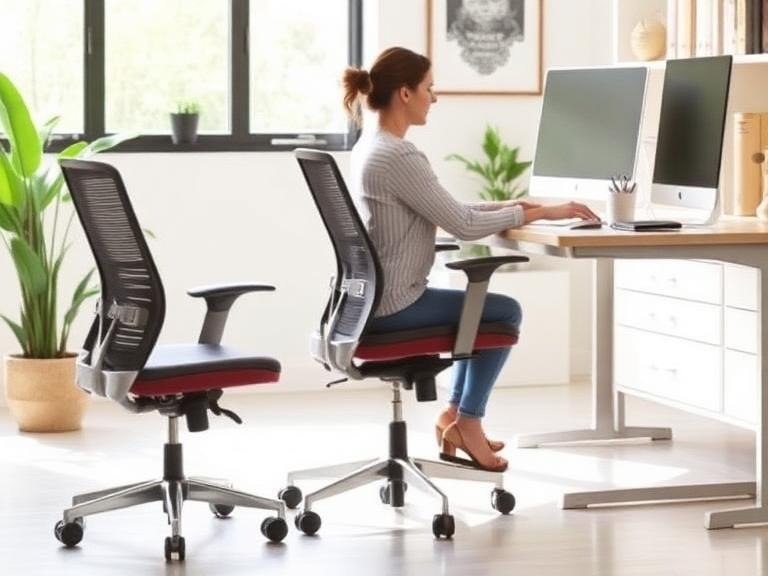
Key adjustments include seat height, seat depth (seat slide), armrest height and angle, and backrest tilt tension. This customization ensures that your feet are planted flat on the floor, your knees are at a 90-degree angle, and your arms are supported without shrugging your shoulders.
Comparison: Standard Chair vs. Ergonomic Chair
The following table highlights the functional differences between a basic task chair and a professional ergonomic solution.
| Feature | Standard Task Chair | Professional Ergonomic Chair |
| Lumbar Support | None or fixed (non-adjustable) | Adjustable height and depth |
| Mechanism | Simple up/down gas lift | Synchro-tilt (back moves with you) |
| Armrests | Fixed plastic loops | 3D or 4D adjustable padding |
| Seat Depth | Fixed | Adjustable sliding seat pan |
| Long-term Health Impact | High risk of strain and fatigue | Promotes blood flow and posture |
5. Improved Blood Circulation
Sitting for long periods on a poorly designed chair with a hard seat edge can compress the blood vessels in the thighs. This restricts blood flow to the lower legs, leading to numbness, tingling, and in severe cases, deep vein thrombosis (DVT).
Ergonomic chairs typically feature a “waterfall” seat edge design. The front of the seat curves downward gently, ensuring that pressure is not applied to the back of the knees. This promotes healthy circulation to the legs and feet, preventing swelling and fatigue.
6. Durability and Long-Term Value
While the upfront cost of an ergonomic chair is higher than that of a standard office chair, the long-term value is undeniable. Cheap chairs are often made with low-density foam that collapses within a year and plastic components that become brittle.
High-end ergonomic chairs are built with industrial-grade materials, breathable mesh, and high-resilience foam designed to last for a decade or more. When you calculate the cost per year of usage, a premium chair is often cheaper than replacing a budget chair every two years.
7. Professional Aesthetics
Finally, the visual impact of your office furniture matters. Whether you are working from a home office or a corporate high-rise, your environment influences your mindset. A sleek, modern ergonomic chair signals professionalism and attention to detail. It creates a workspace that looks as good as it feels, which can be a subtle but powerful motivator to start the workday.
In conclusion, your health is your most valuable asset. Treating your office chair as a medical device rather than just furniture is a shift in perspective that pays dividends in health, happiness, and output.
Disclaimer
The information provided in this article is for general informational and educational purposes only. It is not intended as medical advice, diagnosis, or treatment. While ergonomic chairs can support posture, reduce discomfort, and improve overall workplace ergonomics, individual results may vary. Consult a qualified healthcare professional for personalized advice regarding back, neck, or musculoskeletal issues before making significant changes to your seating or workspace. The author and publisher are not responsible for any injury, discomfort, or adverse outcomes resulting from the use of ergonomic chairs.